Articles
Research

Liquidity Changes the Conversation
For years, DeFi rewarded whoever moved fastest toward yield. Today, the question is different.
Yield is available. What is scarce is dependable liquidity.
As markets have matured, deploying capital has become less about identifying opportunity and more about managing exposure across fragmented venues, layered governance, and shifting risk parameters. Under these conditions, withdrawal reliability begins to outweigh incremental differences in APY.
Withdrawal liquidity is not a surface metric. It reflects how much capital can be exited immediately onchain, without waiting for repayment flows or coordinated intervention. In calm markets, that distinction can feel abstract. In volatile ones, it determines outcomes.
The recently published report, Curation as an Infrastructure Layer: kpk’s Design Philosophy, examines this structural shift in detail.
As curated capital has scaled, allocators are evaluating not only return potential, but how capital behaves when utilisation spikes and liquidity compresses.
Curation, in that context, becomes less about selection and more about behaviour.
Design Before Reaction
Delegation and curation are often discussed together. Structurally, they reflect different approaches to risk.
Delegation concentrates authority in a manager. When conditions change, response depends on judgement and coordination. Even in disciplined mandates, execution follows deliberation.
Curation defines the operating framework before capital is deployed. Eligible markets are pre-approved. Exposure caps are explicit. Diversification rules are embedded. Liquidity buffers are intentional. Risk signals have predefined response paths.
The distinction is structural. Delegation relies on trust in individuals. Curation expresses policy through permissions.
Example: When EURC Liquidity Compressed
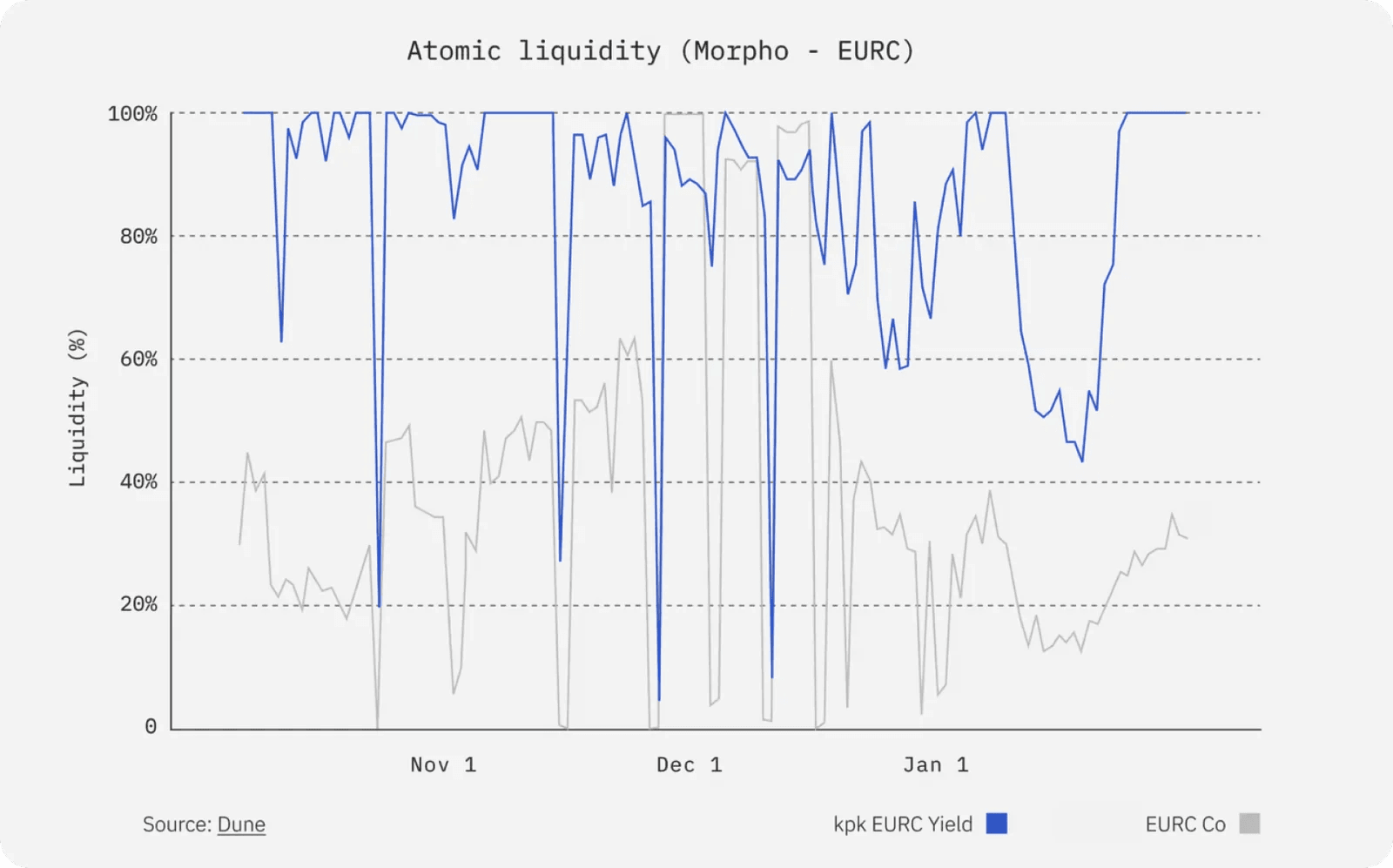
The distinction became visible during a period of liquidity stress in EURC lending markets on Morpho.
Utilisation in several markets climbed above 97%. As borrowing demand absorbed available supply, withdrawal liquidity across multiple vaults compressed rapidly.
In kpk-operated EURC vaults, the breach of predefined utilisation thresholds automatically triggered the Exit Agent. Exposure to the affected markets was reduced within approved permissions. Capital was reallocated. Idle balances were rebuilt.
The sequence executed within seconds. Approximately 19% of vault liquidity was restored almost immediately. Elsewhere, vaults dependent on manual coordination remained effectively illiquid for hours.
The difference was not superior forecasting. It was design.
This response path was not improvised. It was embedded across markets through predefined utilisation and liquidity parameters. Design decisions made months earlier shaped withdrawal outcomes in minutes.
Risk Is Decided Upfront
Curation is not only about responding well under stress. It is about deciding in advance what risks are acceptable and in what proportions.
The report outlines several structural dimensions that differentiate curated vault architectures:
Market eligibility criteria
Concentration caps per asset
Diversification across issuers and protocol dependencies
Liquidity buffer targets
Automated rebalancing cadence
These parameters define the strategy’s risk surface.
Higher-yield markets often come with thinner withdrawal liquidity. Tighter caps may reduce peak performance. Larger liquidity buffers can lower average utilisation. More frequent rebalancing increases operational complexity.
The trade-offs are inherent. The difference lies in whether they are encoded before stress or negotiated during it.
In curated architectures, guardrails are operational. They define what the system is permitted to do. When volatility arrives, capital behaves within predefined limits.
For allocators, that reframes risk from a question of confidence to a question of structure.
Competitive Yield Within Guardrails
Security-first architecture does not imply yield sacrifice.
Automated rebalancing agents monitor market conditions continuously. When spreads widen or incentives shift, allocations adjust within approved limits. Exposure rotates toward markets offering improved risk-adjusted return while maintaining liquidity buffers and concentration caps.
This responsiveness allows curated vaults to remain competitive on yield without abandoning discipline. The objective is not to pursue the highest available APY at any moment. It is to capture sustainable yield within clearly defined boundaries.
Yield and liquidity are not opposing forces. They are balanced through policy-enforced execution.
Discipline Compounds
As DeFi matures, differentiation will not be defined solely by yield spreads.
It will be defined by behavioural predictability.
Periods of stress compress liquidity, expose coordination delays, and test response mechanisms. In those moments, architecture matters more than intent. Curation, implemented through explicit guardrails and encoded response paths, becomes more than selection. It becomes execution discipline.
Architecture determines how capital behaves when conditions deteriorate. In mature markets, that difference compounds.
Read the full report: Curation as an Infrastructure Layer: kpk’s Design Philosophy
Share this article